
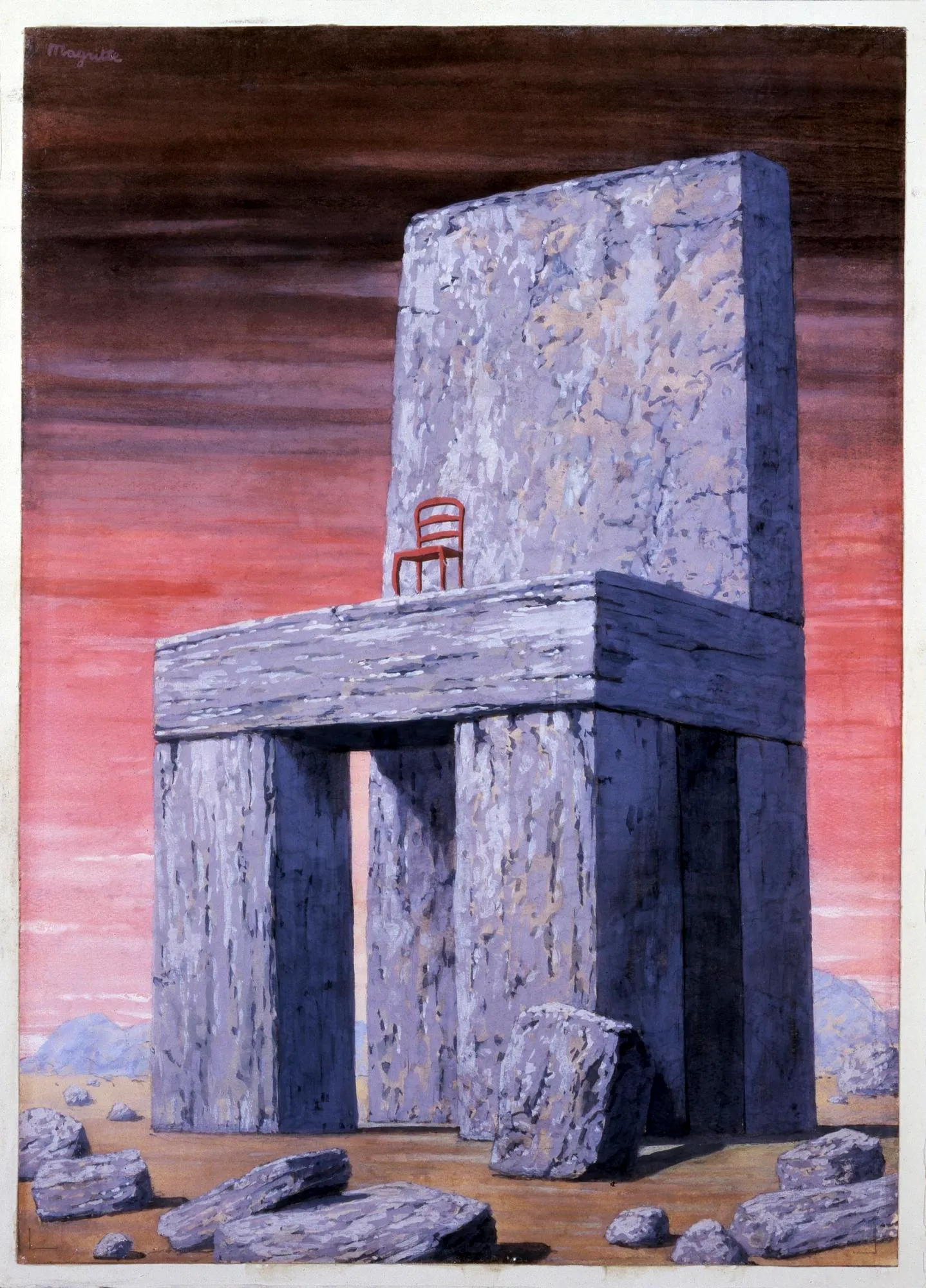
Header image: Those Who Cannot Remember the Past Are Condemned to Repeat It (Great Ideas of Western Man), René Magritte, ca. 1962 · Smithsonian American Art Museum ↗
Aureliano, Aureliano, Aureliano. The Buendías give their children the same names, making it difficult to keep track of who belongs to which generation. What is more interesting, however, is that Úrsula herself understands the family through these repetitions, associating the Aurelianos with a withdrawn disposition and the José Arcadios with impulsiveness. She lives through generations of the family and recognizes these tendencies in her descendants, yet the repetition continues. Why do we repeat the mistakes of the past even when we know how they ended?
The novel follows the Buendía family through seven generations in Macondo, a town founded by José Arcadio Buendía and Úrsula Iguarán. José Arcadio becomes engrossed in the discoveries brought to him by the travelling gypsy Melquíades, and in scientific experiments of his own, while Úrsula maintains the household. Their son, Col. Aureliano Buendía, spends his life fighting civil wars before withdrawing into his workshop in Macondo to make small gold fishes. Macondo itself grows from an isolated settlement to a town well-connected with the outside world by way of a railroad and a foreign banana company. When the company’s workers strike, they are massacred by the army, but official accounts deny said massacre ever taking place. Years of continuous rain follow, the banana company leaves, and the town falls into rapid decline. The remaining Buendías retreat further into Macondo, where Aureliano Babilonia finally deciphers the manuscripts of Melquíades. Within those manuscripts is the entire history of the Buendía family, including the moment in which he is finishing them. As he finishes the manuscripts, Macondo is swept away by a powerful wind.
Aureliano Babilonia finishes comprehending his family at the exact moment he can no longer save it. The manuscripts have existed for generations, but their contents only become clear as their contained events come true. Úrsula, however, doesn’t need the manuscripts to recognize the repeated patterns that hold true within her family. She watches it happen, remembers those who came before, and lives long enough to see her descendants follow said patterns. Her position is more troubling because she has the opportunity to intervene that Aureliano doesn’t, but her observations are not heeded by the rest of her family, and instead each of her descendants, who inherit the names of the past, encounters the consequences as if they were never warned.
Halbwachs’ concept of collective memory is one way to understand this repeated failure to learn from the past. His argument is that our memory is contingent upon the social groups we belong to, which shape how we reconstruct and comprehend past events. José Arcadio Segundo survives the massacre of the banana workers, only to return to a town where the official account insists that nobody died. He recalls an event that the people around him deny ever happened (much like the Colombian Banana Massacre, the Paris Massacre of 1961 and the Tiananmen Square Massacre), but his memory has no place in the version of Macondo’s history accepted around him. The exact same social dependence that allows memories to be passed down generation-to-generation leaves them vulnerable to selective exclusion.
The Colonel’s return to make gold fishes is more difficult to explain through collective memory. He has lived through the wars himself, making his knowledge of them less dependent on the beliefs of others. Yet he spends his later years making gold fishes just to melt them down to begin again. Unlike the other generations of his family, he is fully aware of this repetition. The repetition is deliberate, but his withdrawal matters more than the fishes themselves. He leaves the wars behind without becoming closer to the people in his own life.
Aristotle argues in the Second Book of Nicomachean Ethics that character is developed through repeated actions. People become just by acting justly, much as they become skilled musicians through practicing music, skilled carpenters by practicing their carpentry, or skilled writers by practicing writing. He compares those who study virtue without putting it into practice to patients that listen to a physician without following the treatment. Úrsula’s warnings fall similarly upon the deaf ears of her descendants hearing her experience. But the hearing of what happened to their ancestors makes no difference in how they treat one another. The Colonel gives demonstrates this well, with his involvement in the wars being finished, just for him to keep others at a distance within his own home, abandoning the activity without abandoning the withdrawal that accompanied it.
While groups do have their own habits and tendencies, in Macondo, denying the massacre becomes among those habits. One would inherit the habitual denial while learning of the history of Macondo without needing to have been a participant in the concealment of the massacre that happened in the first place. Each retelling of the history of Macondo would give the next teller the same filtered story to repeat to future generations, with those responsible for originally suppressing it not having to remain present for their version to live on past their own time.
We repeat the mistakes of history because knowing their consequences alone does not free us from the habits that produced them. What gets passed down generation-to-generation already contains ways of avoiding what would be difficult for one to accept. Every society on the face of the planet does something similar to the Buendías, intentionally or not. The Colombian government denied the Banana Massacre, the French kept the killing of Algerian demonstrators in 1961 out of public discussion for decades, and perhaps most famously, Tiananmen remains censored to this day. The inheritors of the silence are not the inventors of it, oftentimes just repeating the information they were given. Santayana wrote that “those who cannot remember the past are condemned to repeat it,” but truly learning from it requires changing the habits we would otherwise carry forward.

