
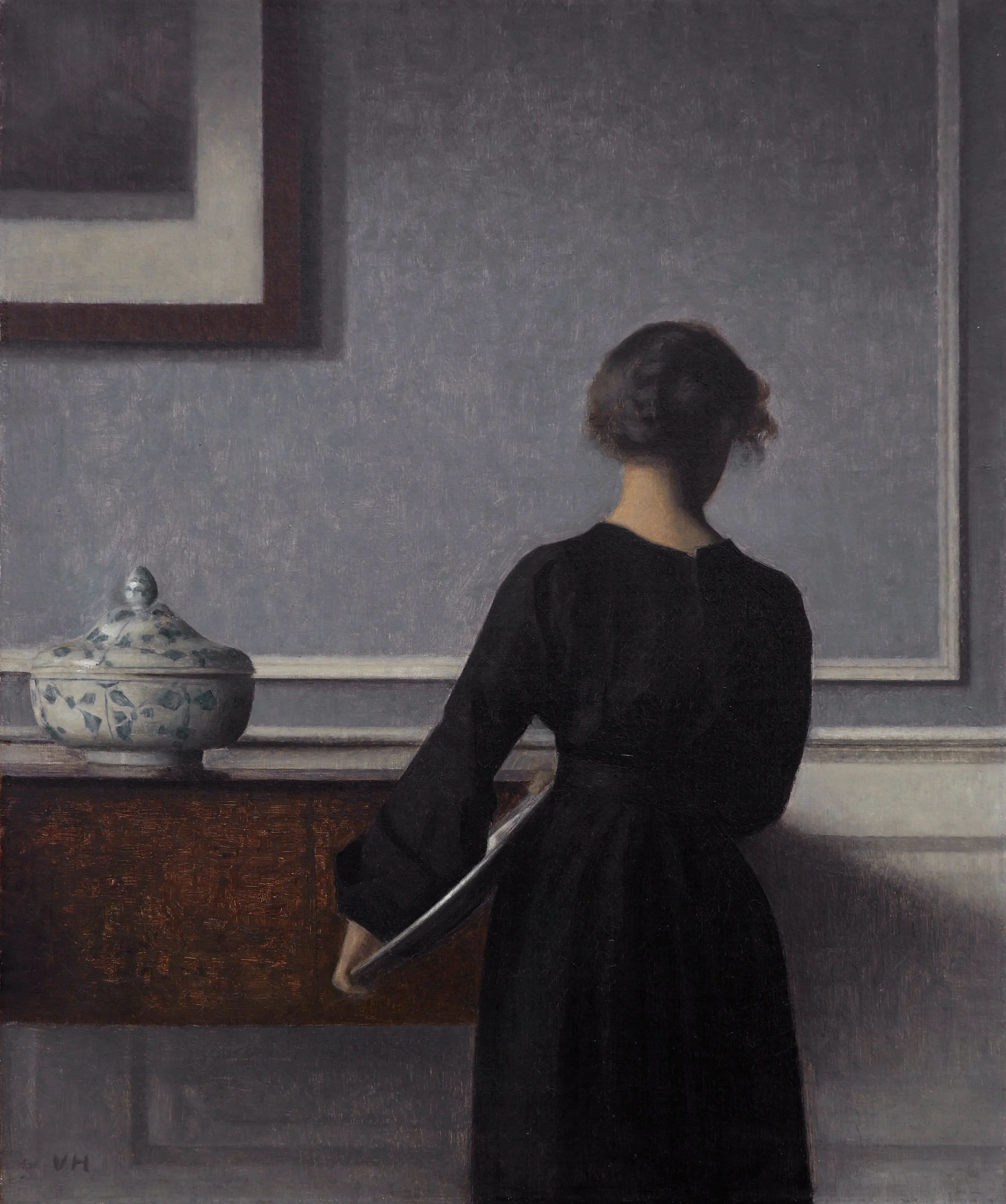
Header image: Interior with Young Woman Seen from the Back, Vilhelm Hammershøi, 1904 · Public domain ↗

Toru, 37 years of age, arriving on a plane into Hamburg overhears an orchestral version of Norwegian wood, ripping him back to his youth where he once strolled the outskirts of Tokyo with Naoko. Similar to Proust’s tea soaked Madeleine in In Search of Lost Time, he doesn’t control this flood of memory, and has to sit back and let it happen. What is more intriguing is the incompleteness of this flood. He remembers the meadows, the mountains, and the landscape very vividly, while his memory of Naoko’s face stays just out of reach, remaining elusive despite the fact that she is supposed to be the central figure of the memory.
But what does he mean when he says he writes so as not to forget Naoko? She had asked him to remember her, but remembering someone and recalling that memory accurately are very different things. As the survivor, Toru hold the power to shape Naoko’s image post mortem. The Naoko the reader is presented with is filtered by his memory, in this sense, being much like the train window through which Shimamura observes Yoko through in Kawabata’s Snow Country, standing between the observer and the observed.
This idea of memory’s filtered preservation became more intriguing as I looked more into the concept of memory itself. I had always assumed that recalling a memory was like opening a book that had sat untouched in a library since the event happened, but research on memory reconsolidation shows that when a memory is reactivated, it becomes temporarily unstable before being stored again in an altered form. In a chapter from Memory, the authors describe memory as a more participatory process, with recollection helping to reconstruct one’s identity instead of reproducing the past exactly as it was. Whenever Toru thinks back to Naoko, he isn’t unearthing an untouched memory of her that has lain dormant for the past eighteen-or-so years, but he is actively constructing an image of her that can exist in the present.
Toru says he began writing so as not to forget the fading memories of Naoko, but the very act of him recalling his memories of her to write them down requires him to reconstruct them, attempting to preserve the memories through a process that fundamentally alters them. If Naoko has begun to slip from his memory, the image he presents on the page may well have become a substitute for the person he fears losing. While he can preserve this image indefinitely, that does not mean the image is identical to the person herself. Naoko herself seems caught in a tangle similar to the one from the past. A childhood friend of Naoko and Toru, Kizuki, commits suicide by piping his exhaust into his car, and turning the car on so as to die by carbon monoxide poisoning. This suicide, occurring very early on in the text, becomes a pivot around which both Naoko and Toru’s lives have been reshuffled. Interestingly though, Kizuki leaves the world without so much as a note, or a shred of explanation for why he killed himself. But this lack of explanation is exactly the point. Both Toru and Naoko are forced to build their lives around an event that defies comprehension. They fail to find an answer that miraculously makes his death a rational event. Naoko’s struggle to move beyond this is reflected in the evolution of her and Toru’s relationship. In Freud’s “Mourning and Melancholia,” Freud distinguishes between grief that allows a person to redirect themselves toward the world and a separate, more consuming type of loss in which the lost person becomes part and parcel of a mourner’s identity. Neither Naoko nor Toru seems able to simply leave Kizuki in the past. Naoko’s image of the hidden well in the meadow represents this within the novel. One could walk through the meadow where the well is located, not knowing it is there as there are no markers of any sort around it, and fall into the bottomless pit, cutting them off from the outside world. While there is a contrast between Naoko and Midori insofar that Naoko can be interpreted as representing death and the past while Midori represents life and the future, it is a little too neat to be accurate. However, the distinction is still useful. Naoko’s primary way of reaching toru is through memory, while Midori calls him, meets him, gets angry with him, asks him where he is, and forces him to actually make decisions.
The distinction between the two becomes much harder to view as a symbolic thing after Naoko kills herself, which I found to be the most jarring moment in the book, but it really shouldn’t have been, since death was thoroughly surrounding her from the beginning. Kizuki committed suicide just as Naoko’s older sister did, and Naoko herself spent a large part of the novel grappling with severe mental health issues. While the possibility of her suicide wasn’t something hidden, it remained a possibility the reader hopes to not come true.
What changes after her suicide is not just Toru losing her, but that his understanding cannot be corrected by Naoko any more. Before her death, no matter how distant she seemed, she still existed, writing letters, recovering, getting worse, passing in and out of Toru’s life. His understanding of her remains subject to change, as she still exists as an independent person capable of contradicting his mental image of her. After she dies, there is no more new information about her for his mental model to encounter, and everything following happens within a combination of her letters, Reiko’s account (a fascinating character by the way), and his memory and own attempts to reconstruct the past.
This reconstruction is somewhat similar to Gaussian Splatting, a technique that reconstructs a three-dimensional scene from a set of photographs at different viewpoints, representing the scene through thousands of three-dimensional Gaussians whose characteristics are adjusted until the rendering matches the original images. The resulting scene is then able to be viewed from positions where no photograph was taken. Toru’s memory of Naoko after her death is similar, instead of various image characteristics he has observations of her from particular moments and angles. He fills the space between those memories as well as he is able to, but he can no longer obtain new observations of Naoko herself.
Reconstructed scenes from real images can contain perspectives that were never shot, and Toru’s remembered Naoko seems to exist in a similar way. The image of her he puts onto the page is assembled from genuine pieces of her life, but the connections between those pieces are increasingly influenced by him the more he tries to remember.
Toru doesn’t succeed in preserving Naoko as she was, and he never could have. He preserves the relationship between himself and the memory of her. Remembering someone requires selecting certain things and losing others, and eventually the remembered image can begin to replace the person who is supposed to be remembered.
Perhaps the closest we get to remembering someone is recognizing that distinction, and accepting that what remains in our head, while something real, is no longer them.