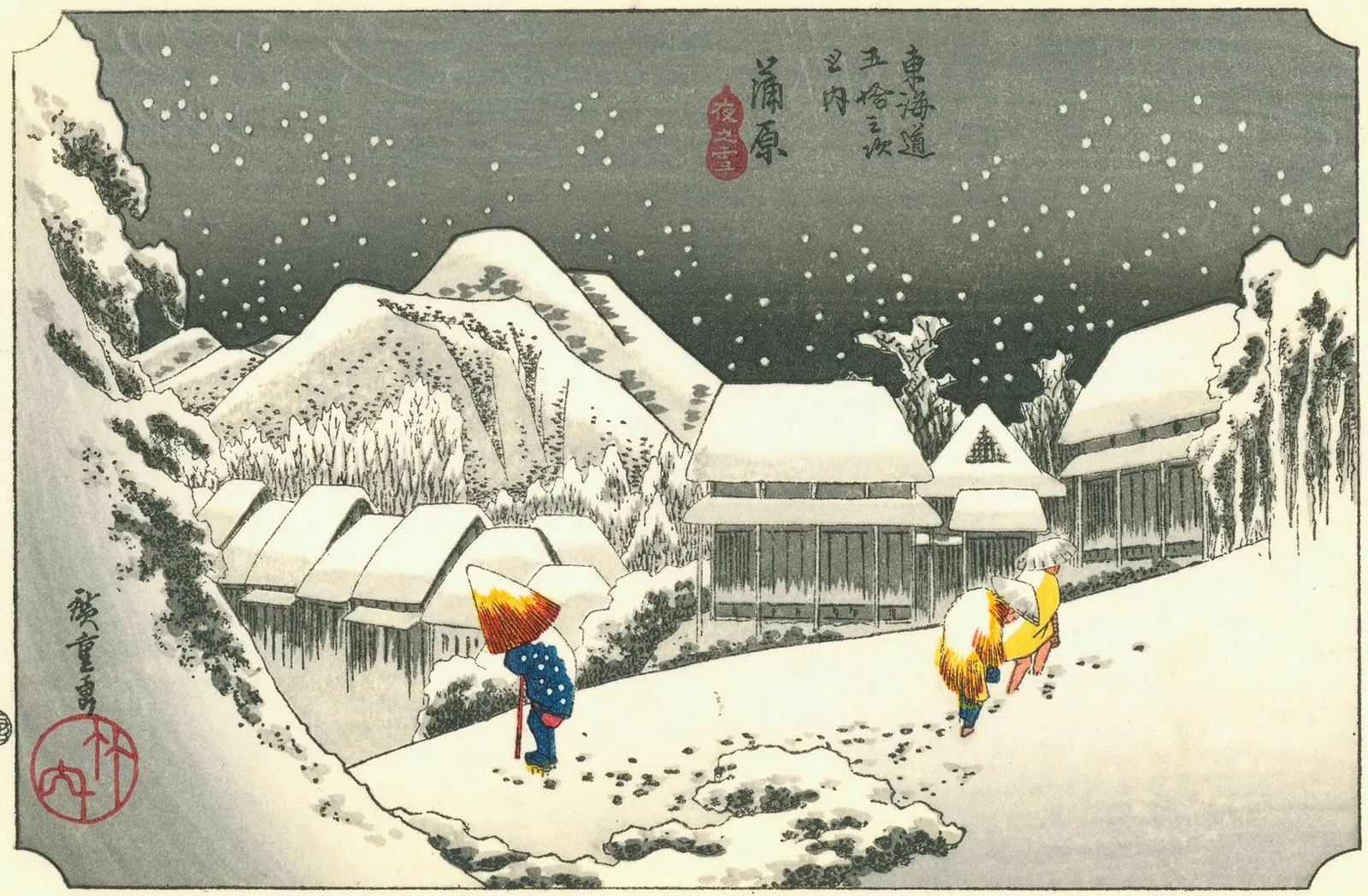
Header image: Night Snow at Kanbara, Utagawa Hiroshige, 1833–34 · Public domain ↗
The novel starts with our protagonist, Shimamura, watching a mysterious girl named Yoko through her reflection in a train window. He isn’t just watching her, but sort of studying her, experiencing her, as a combination of her person, her reflection, and the darkness over the landscape outside. This theme of a mediated interaction tends to recur throughout the book, with Shimamura noticeably being more comfortable when there is something separating him and the person he is interacting with. The distance gives him control, with Yoko staying a mystery to him because he doesn’t quite know her yet. He can turn her into an image in a sort of de-personification without having to deal with any of the problems associated with actually getting to know her as a person. Similar things happen in other parts of Shimamura’s life, he studies Western ballet, without ever seeing it performed, and seems more interested in ideas the further away from him they are. This gets noticeably more difficult with Komako, a geisha in a mountain town that Shimamura starts to visit regularly. Her nature as an individual destroys Shimamura’s ability to admire her from a distance. She is emotional and occasionally drunk, while also being rather disciplined in her practice of the Shamisen. Komako is painfully aware of the fact that Shimamura will inevitably leave her, and the more time they spend together, the less Shimamura can maintain her as just another beautiful image. Komako starts to become more specific, starts to want things from him, she remembers what he says and expects the same from him. This seems to be where Shimamura starts to get uncomfortable.
This was where I started to wonder at Shimamura’s definition of their relationship. Whether he actually loves Komako or he just enjoys feeling loved. Shimamura is clearly attracted to her and fascinated by her, but the distant fascination is far easier than real responsibility, from a distance he can admire her fiery emotions without having to match them. When exploring this idea, which I had noticed in my own life, but I didn’t quite have a good term for, I found that Edward Bullough described it pretty well with his concept of “psychical distance”, the separation allowing us to stop responding to stimuli in practical terms and start experiencing aesthetically. This very nearly matches what Shimamura is attempting to create between himself and others. With Yoko, it is the train window. With ballet, it is the geographical distance he has from it, and his own refusal to experience it directly. With Komako, it starts to break down because of her intentional entry into his life. This “psychical distance” is not inherently negative though. Some sort of distance is necessary for the appreciation of art. Looking at a painting as simply the medium sitting in front of you, or listening to music as random vibrations and pitches strung together by a composer would miss the exact thing that makes the experience interesting.
This becomes more interesting with the context of Kant’s idea of pleasure in beauty being “disinterested”, that we can find beauty in something without the desire to possess it or get anything practical out of it. Which obviously makes sense when discussing pieces of art, or inanimate objects one observes. I do not need to own a place like Philmont to find it beautiful, nor do I need to own Winslow Homer’s Herring Net to admire it (although that would be nice). The problem is where this gets carried into interactions with other people. Most of Shimamura’s fascination with Yoko revolves around visual or sensory cues: her voice, her face, etc. He knows next to nothing about her as a person, and prefers to keep it that way, keeping his mental image of her similar to a portrait on the wall. This does seem to be reflected in how flat Kawabata made the characters, so the reader can experience this psychical distance along with Shimamura. But this disinterested beauty falls apart with Komako, because she makes it personal. Philmont or the Herring net does not care if I walk away to stop admiring the beauty, but Komako does. This difference also changed how I saw Shimamura’s descriptions of Komako’s shamisen talent as “wasted”. Shimamura seems to find something beautiful and tragic in the fact that she practices the shamisen with rigid discipline despite living in an isolated town where that practice seems to lead nowhere. Originally I sort of concurred with his point there, but the more I thought about it, the stranger his definition of waste became to me. Komako throws herself completely into whatever she cares about, whether that be her reading, her practice, remembering things about others, or loving people. While Shimamura has far more freedom than she does, he chooses to stay distant from everything in his life, so it is understandable that from his point of view he would call her effort wasted, but she might be the character wasting the least.
Martin Buber’s distinction between “I-It” and “I-Thou” relationships gave me another way to think about Shimamura’s interactions with others. In an I-It relationship, others become experiences, descriptions, categories, or sets of practical qualities. An I-Thou relationship is encountering the other person as a complex subject whose existence cannot merely be reduced to the incomplete set of things you know about them. Shimamura notices the most minute changes in Komako’s appearance, in her Shamisen playing, Yoko’s voice, and even the way light changes a reflection in a window. Despite all these observations he still neglects to encounter others in an I-Thou type of relationship, opting instead to turn these observations into collections of interesting characteristics. He knows things about Komako, but never tries to encounter her as someone who exists independently of his experience of her.
Shimamura also doesn’t limit this relational I-it experience to people, but he does the same thing to the Snow Country itself. John Urry’s concept of the “tourist gaze” speaks to this, arguing that tourists do not experience a place neutrally, but perceive it by distinguishing “everyday life” from elements at the destination that appear extraordinary, picturesque, or noteworthy, precisely the approach Shimamura takes toward this small town (Urry on the tourist gaze, trash ref here) . The beautiful sense of detachment Shimamura feels there is nothing more than daily life to Komako.
In his lecture Japan, the Beautiful and Myself, Kawabata explains the emphasis placed on changing seasons and natural scenery in Japanese culture. He does not view beauty as something isolating, but believes that encountering it evokes thoughts of loved ones and a desire to share the experience with them. Shimamura, despite his aesthetic sensibility, distances himself from others when he finds beauty in them.
This does not mean that aesthetic appreciation is an issue, in Kawabata’s view, beauty is to serve as a bond that brings people closer together. The issue lies in Shimamura’s use of aesthetic abstraction and appreciation to maintain a distance from the outside world. Although he keenly perceives the world around him, he rarely experiences the kind of fellow feeling described by Kawabata. His aesthetic sensitivity is divorced from the interpersonal connections that give it meaning, which is what makes it problematic.
When the warehouse catches fire and Yoko falls, confronted with a sudden crisis where maintaining aesthetic distance should be impossible, Shimamura’s perception nonetheless turns back to the surrounding scenery. When reality becomes imminent and terrifyingly cruel, his instinct remains to perceive it through the lens of “beauty”. Kawabata places the reader in a dilemma, for the prose he employs to describe this is itself beautiful. One might criticize Shimamura for transforming suffering into mere imagery, yet simultaneously appreciate that it was from this very suffering that Kawabata created such imagery.
Snow Country helps one realize that there is a difference between seeing things and understanding them. While aesthetic distance may make it easier to appreciate the world, it can also devolve into an elegant way of preventing one from ever truly becoming a part of that world.