
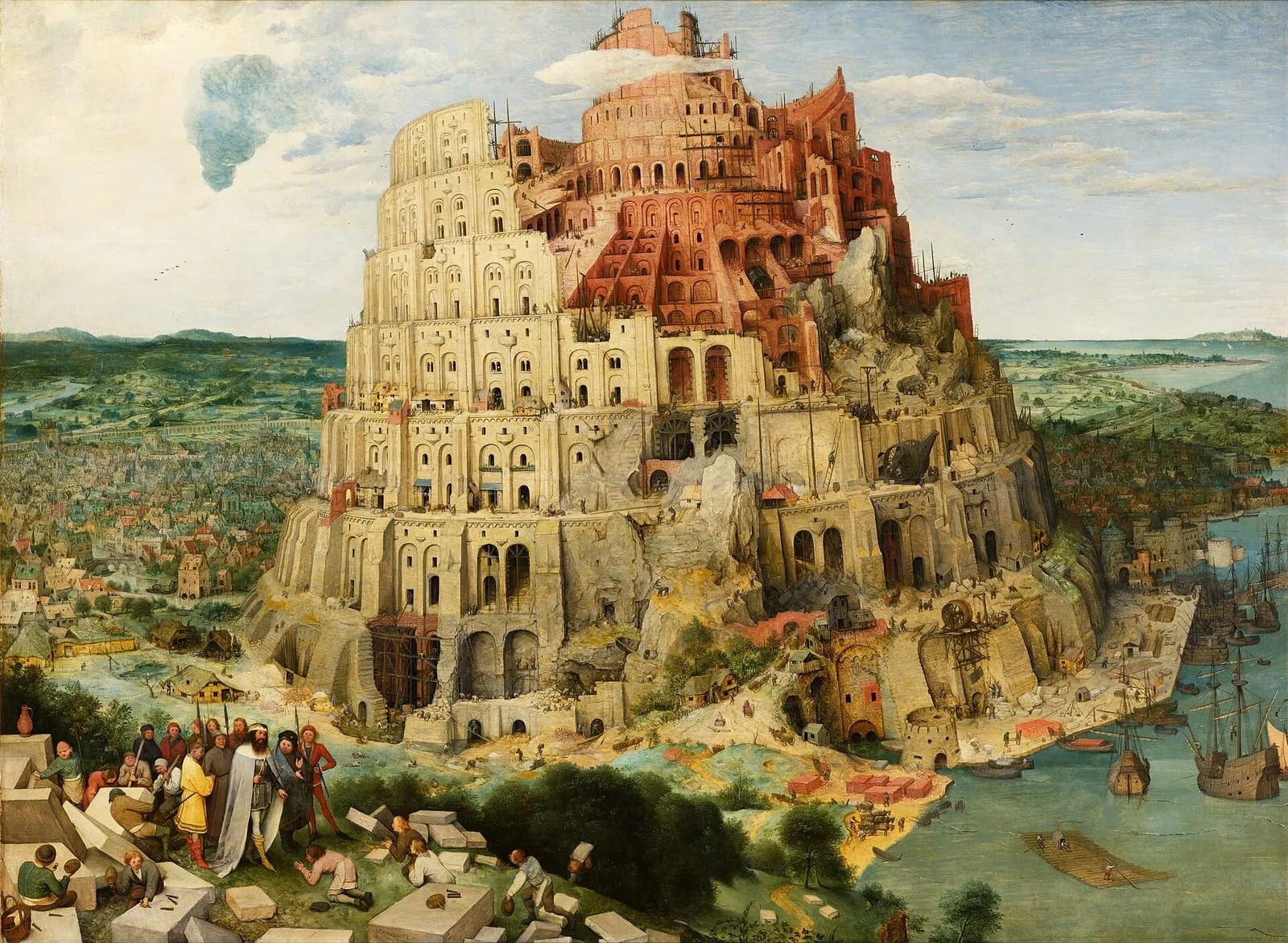
Header image: The Tower of Babel, Pieter Bruegel the Elder, 1563 · Public domain ↗

Calling this a novel might not be entirely accurate. It recreates a scene of Marco Polo describing cities to Kublai Khan, yet it lacks a traditional plot. Polo describes fifty-five cities,which may or may not exist, while Kublai Khan attempts to grasp the true significance of these descriptions. I had expected the cities themselves to be the protagonists. Even more interesting, however, is the implicit tug-of-war between Polo and Kublai Khan regarding what allows a description to endure.
Zaira is the first city to illustrate this point. Polo describes Zaira without naming buildings or streets, defining the city by the connections between locations and their associated events. Distances and heights are linked to executions, processions, memories, and past events. The city’s physical appearance pales in comparison to the web of memories associated with it. This is opposite to the ancient method of loci, using imagined places to organize memory, rather than using places to store memories, in Zaira memories render the places recognizable.
Kevin Lynch explores this in his book The Image of the City. Lynch argues that people organize understanding of a city through paths, edges, districts, nodes, and landmarks. We do not hold complete architectural models of Chicago or New York in our minds, but remember a selected framework and term that framework “the city.” Lynch calls the environment’s capacity to create a clear mental image “imageability”, and the cities depicted by Marco Polo are almost entirely defined by imagery, often as pars pro toto, lacking distinct geographical features.
The chess scene pushes this problem to its furthest extreme. The Khan reduced his empire to its simplest form as cities became patterns, which in turn became arrangements on a board, and the entire empire collapsed into a wooden playing surface. If the Khan could reduce everything to a few rules and a handful of pieces, he might grasp the nature of the realm he ruled. Polo observes the board itself, showing how the texture of the wood, bearing traces of its growth, felling, transport, and the labor involved, reveals the history that had created it. This seemingly simple object held within it another history almost as complex as the empire it represented.
This brings to mind Borges’s paragraph-long “On Exactitude in Science,” in which a group of cartographers becomes so obsessed with precision that they create a map the same size as the empire it depicts. The map becomes useless because it omits no detail whatsoever. It is a reductio ad absurdum of perfect representation: representations must leave something out, or else it ceases to be a representation. Borges’s map was useless because it encompassed everything and the Khan’s chessboard was rendered meaningless by what it omitted.
The mathematical structure of Invisible Cities appears to have been planned. Fifty-five cities organized into eleven categories, arranged in a strict sequence across nine chapters. I assumed that Calvino devised a system first and then populated it with cities. But in a 1983 lecture at Columbia University, Calvino explained that he spent years composing the chapters on the various cities, initially conceiving them as independent poems. Only after a certain number of these independent poems did he start to classify them and arrange them into eleven groups.
This history also complicates direct comparisons with the Oulipo group, which is dedicated to literature based on formal constraints and mathematical systems. Calvino was formally co-opted into the group in 1973, after the publication of Invisible Cities. While Calvino later described the book as resembling a polyhedron rather than a linear narrative, his creative process stood in contrast to the concepts of Oulipo’s constrained writing since the cities generated the systems rather than systems generating the cities.
One is inclined to look to Venice to unravel this. When the Khan pointed out that Polo never described his home, Polo explained that the cities he described all held a fragment of the Venice he held in his heart. Polo’s Venice is not some hidden archetype, but a system capable of spawning permutations. Venice does not exist concealed beneath other cities as a “correct answer”, it is an amalgam of memories and the very elements that enable him to understand other cities. Reminiscent of Norwegian Wood, wherein Toru worries that the act of describing Naoko will crystallize the fixed image in his memory, in turn supplanting the real Naoko. Polo has a similar concern with Venice, naming it directly is to risk crystallizing his fluid memories into something rigid. Description preserves memory and forecloses other possibilities through abstraction. Once a thing is committed to writing or speech, the words become a method for recall that is far more concrete than the unstable memory that preceded it. Each city magnifies a specific quality inherent to real cities. Some simplify into memory, desire, signs, or a state of precarity. This impossible premise is a thought experiment, highlighting elements that vanish with the minutiae of our daily lives so that they may be more closely examined.
While abstraction makes our world easier to control, it erases things that should be cherished. We turn our cities and towns to names and figures for management, but this very act makes it difficult to truly see the city. Polo preserves the details that vanish first in our typical descriptions. The places we visit do not stay in our memories as exact replicas of their original forms, they exist as surrogate shapes made of the connections, omissions, and stubborn details we have selected, either implicitly or explicitly.
A map is not the territory it depicts, yet it is precisely through the discarding of information and the use of empty space that the territory becomes intelligible.