
Project
ARGUS — Electro-optical tracking system
How do you move a camera through two axes without losing its view or damaging its ribbon?
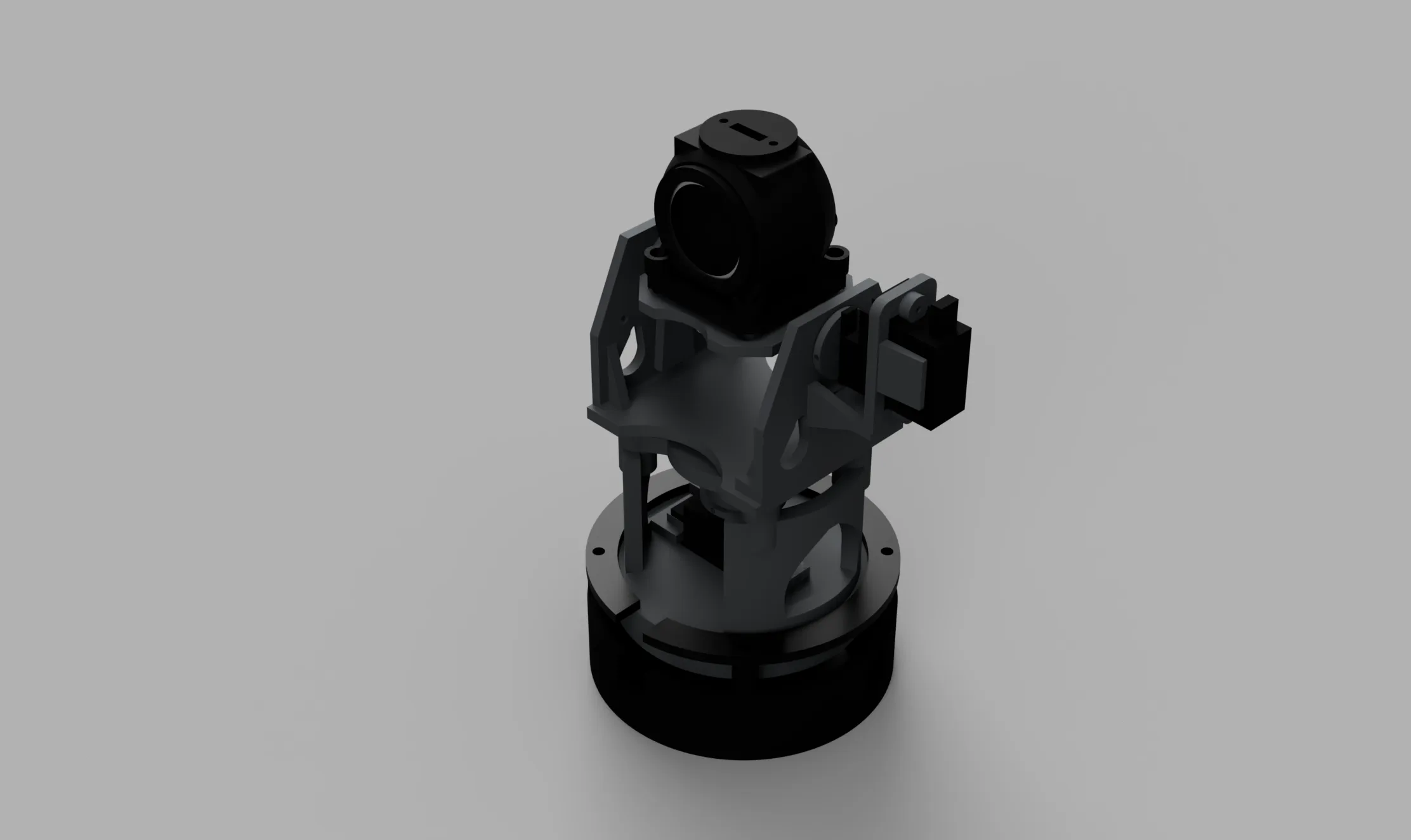
A camera tracker sounds simple until the camera starts moving and the computer stays put. In ARGUS, the camera sits inside a spherical head on the CORE pan-and-tilt gimbal. A Raspberry Pi processes the image from a stationary location, and an ESP32 commands the two servos. That split keeps the Pi's weight off the moving head, but it also means the camera ribbon has to follow every movement of both axes.
The ribbon became the hardest part for me to think through. I could check where the printed pieces would be at a series of pan and tilt angles, and the design reports found no solid-body collisions in those positions. A cable does not behave like a printed part. It can pull on the camera connector, rub against an edge, or fold too sharply after many cycles. I also had to leave the lens a clear view through the spherical shell. The housing could look perfect from the outside and still make the camera less useful if its opening blocked part of the image.
Once I decided to keep the Pi stationary, the division of work was unexpectedly clear. The Pi would handle images; the ESP32 would handle motion. I still have to settle how those boards exchange commands, but I no longer had to fit every electronic part on the gimbal. My favorite part was designing the spherical head around the actual optical path. Centering the camera and shaping the aperture gave the assembly a purpose beyond holding a board in place.
I think about that problem when I look at the L3Harris WESCAM MX-10 RSTA, a stabilized electro-optical/infrared sight used for reconnaissance and surveillance. Its sensors and stabilization are far more advanced than ARGUS, yet the line of sight still depends on the mechanical system carrying it. ARGUS taught me that tracking is more than writing code that says “turn toward the object.” The moving mass affects the servos, the housing affects what the camera sees, and the cable may set a tighter travel limit than the joints. The next test I would trust most is a real ribbon moving through the full intended range.